
Working Papers

คณะสถิติประยุกต์ได้จัดกิจกรรมนำเสนอผลงาน Working Papers
ภายใต้การจัดงานประชุมวิชาการระดับชาติและนานาชาติ 4th NIC – NIDA Conference, 2025
สถาบันบัณฑิตพัฒนบริหารศาสตร์
โดยได้รับเกียรติจาก รองศาสตราจารย์ดร.เชาวลิต จีนอนันท์ และรองศาสตราจาร์ ดร.นิธิเดช คูหาทองสำฤทธิ์เป็นผู้วิพากศ์บทความ

Authors
Mongkol Hunkrajok , Wanrudee Skulpakdee
อาจารย์ คณะสถิติประยุกต์ สถาบันบัณฑิตพัฒนบริหารศาสตร์
Abstract
Recently, non-monotonic rate sequences of pure birth processes have been the focus of much attention in the analysis of count data due to their ability to provide a combination of over-, under-, and equidispersed distributions without the need to reuse covariates (traditional methods). They also permit the modeling of excess counts, a frequent issue arising when using count models based on monotonic rate sequences such as the Poisson, gamma, Weibull, Conway-Maxwell-Poisson (CMP), Faddy (1997), etc. Matrix-exponential approaches have always been used for computing the probabilities for count models based on pure birth processes, although none have been proposed for them as a specific algorithm. It is intractable to calculate these pure birth probabilities numerically in an analytic form because severe numerical cancellations may occur. However, we circumvent this difficulty by exploiting a Taylor series expansion, and then a new analytic form is derived. We developed a simple algorithm for efficiently implementing the new formula and conducted numerical experiments to study the efficiency and accuracy of the developed algorithm. The results indicate that this new approach is faster and more accurate than the matrix-exponential methods.

Authors
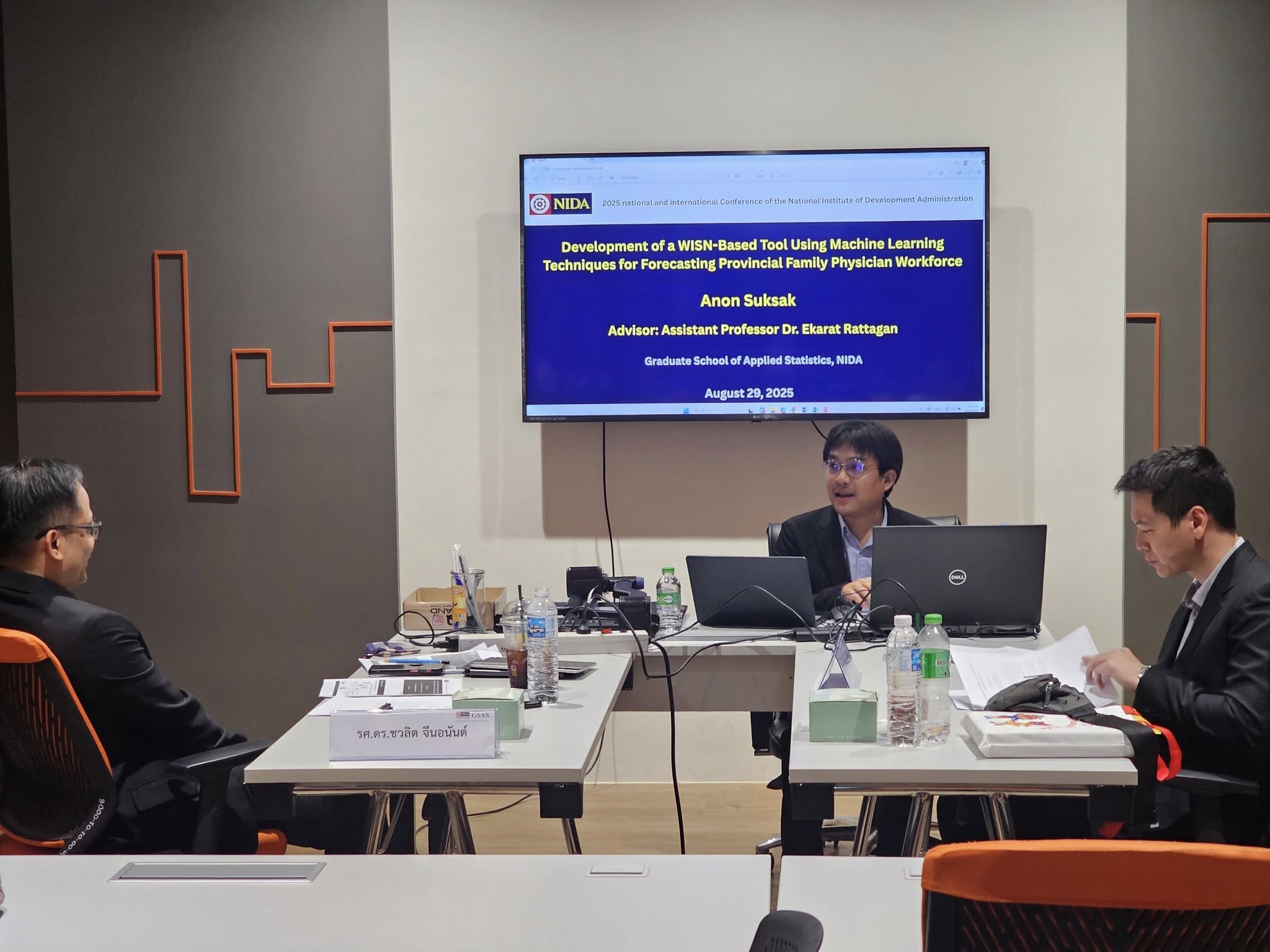
อานนท์ สุกสัก,เอกรัฐ รัฐกาญจน์
นักศึกษา คณะสถิติประยุกต์ สถาบันบัณฑิตพัฒนบริหารศาสตร์
อาจารย์ คณะสถิติประยุกต์ สถาบันบัณฑิตพัฒนบริหารศาสตร์
Abstract
ประเทศไทยกําลังเผชิญปัญหาการขาดแคลนและการกระจายตัวไม่สมดุลของแพทย์เวชศาสตร์ครอบครัว ซึ่งเป็นบุคลากรสําคัญในระบบบริการสุขภาพปฐมภูมิ ท่ามกลางบริบทของสังคมสูงวัยและภาระโรคไม่ติดต่อเรื้อรัง (NCDs) ที่เพิ่มขึ้น งานวิจัยนี้มีวัตถุประสงค์เพื่อพัฒนาเครื่องมือพยากรณ์ความต้องการแพทย์เวชศาสตร์ครอบครัวระดับจังหวัด ระหว่างปี พ.ศ. 2568–2578 โดยบูรณาการแนวทาง Workload Indicators of Staffing Need (WISN) กับเทคนิค Machine Learning (ML) ได้แก่ Random Forest,XGBoost, Gaussian Process Regression และ Linear Regression เพื่อคาดการณ์แนวโน้มบริการสุขภาพ เช่น จํานวนผู้ป่วยนอกและผู้ป่วย NCDs
การศึกษาอยู่ระหว่างดําเนินการ โดยใช้ข้อมูลทุติยภูมิจากหลายแหล่ง เช่น ฐานข้อมูลของสํานักงานหลักประกันสุขภาพแห่งชาติสํานักงานประกันสังคม กรมบัญชีกลาง ข้อมูลประชากรจากสํานักงานสภาพัฒนาการเศรษฐกิจและสังคมแห่งชาติและข้อมูลภาระงานจากการทบทวนวรรณกรรมและผู้เชี่ยวชาญรวมถึงข้อมูลจากโครงการวิจัยระดับชาติเกี่ยวกับการวางแผนกําลังคนแพทย์เฉพาะทางผลการวิเคราะห์จะถูพัฒนาเป็นเครื่องมือต้นแบบในรูปแบบ Spreadsheet ที่ปรับให้เหมาะกับบริบทแต่ละพื้นที่ตัวอย่าง คาดว่าจะช่วยสนับสนุนการตัดสินใจเชิงนโยบายในการจัดสรรกําลังคนแพทย์เวชศาสตร์ครอบครัวได้อย่างแม่นยํา ยืดหยุ่น และยั่งยืน
Authors
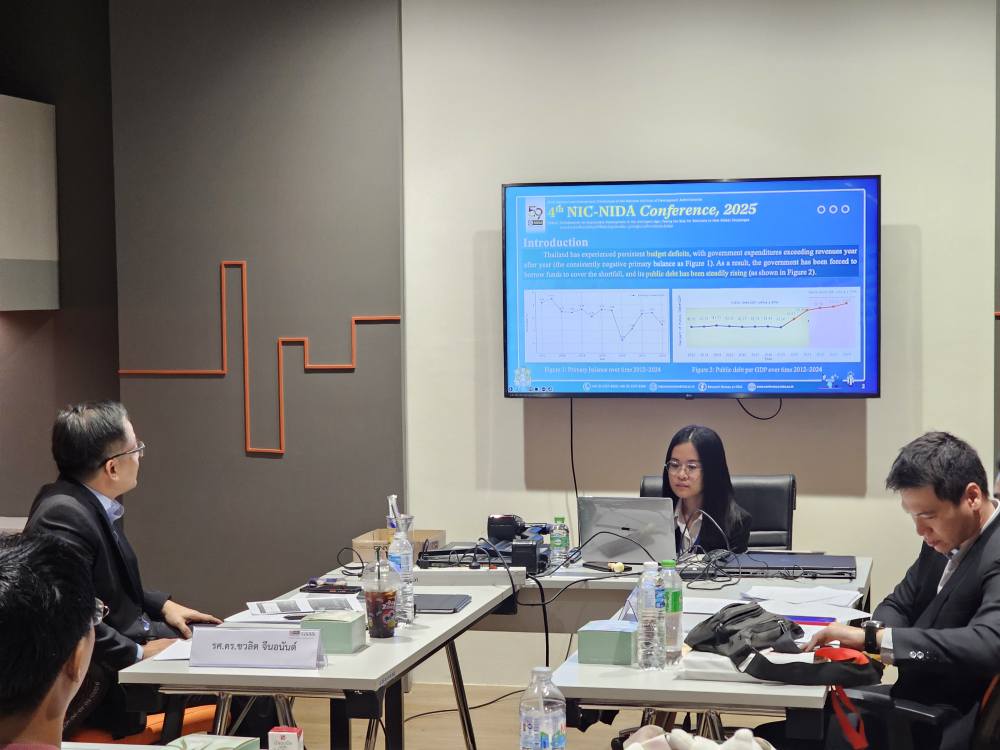
Netnapit Rittisorn , Ekarat Rattagan
นักศึกษา คณะสถิติประยุกต์ สถาบันบัณฑิตพัฒนบริหารศาสตร์
อาจารย์ คณะสถิติประยุกต์ สถาบันบัณฑิตพัฒนบริหารศาสตร์
Abstract
Corruption in public procurement remains a critical challenge that undermines the integrity, efficiency, and transparency of public budget utilization. Traditional auditing mechanisms often struggle to uncover hidden corruption risks—those embedded within complex, large-scale financial transactions and not immediately visible through surface-level inspection. These risks may manifest as subtle anomalies in disbursement patterns or deviations from standard financial practices.
In the era of digital government, a machine learning (ML) approach offers powerful tools to enhance anomaly detection, uncover irregular spending patterns, and enable data-driven oversight. This study applies an ML-based approach to identify such hidden corruption risks by analyzing quarterly financial and procurement data from Thai government agencies. This study employs an ensemble of four unsupervised anomaly detection models—Isolation Forest, AutoEncoder, Long Short-Term Memory (LSTM), and Long Short-Term Memory AutoEncoder (LSTM-AE)—to leverage their complementary strengths. In addition to deploying these models jointly, their individual performance is also compared to evaluate detection accuracy across different algorithmic approaches. These models aim to uncover patterns that deviate significantly from the norm, revealing potential warning signs often undetectable through manual inspection.
Given the absence of verified ground-truth labels, a consensus-based labeling strategy is adopted: a project is considered a high-confidence anomaly if flagged by at least three out of the four models. Among the tested models, LSTM-AE outperforms others, achieving the highest AUC score (0.998), and proving particularly effective in capturing long-term temporal dependencies in public financial data.
This study demonstrates that a machine learning approach can be applied to public financial management to uncover hidden corruption risks. By combining multiple unsupervised models, the approach offers a scalable tool for detecting red flags across key stages of the budget process—such as approval, expenditure tracking, and auditing. It provides a practical and interpretable framework to support policymakers and oversight bodies in proactively identifying high-risk projects and enhancing transparency in the public sector.
 TH
TH  EN
EN